Article Accepted

I received news tonight that my article “Arbitrary Allegory, Typical Typology, or Intertextual Interpretation? Paul’s Use of the Pentateuch in Galatians 4:21-31” was accepted for publication in Biblical Theology Bulletin. It still has to go to the copy editor, and I have no clue on the timeline for publication. But, the hard part is over.

I’ve been looking for a home for this article for a year now, and its been a hard search. This is probably my favorite piece from what I’ve worked on so far (even my dissertation – but who likes their dissertation anyway?), so I’m excited that the LORD has blessed me with the opportunity to publish it.

Here’s the abstract:

“This article begins by surveying the modern history of interpretation of Gal 4:21–31, and in doing so demonstrates that virtually no commentators from the time of Calvin have concluded that Paul accurately conveys the message of the Pentateuch’s narratives to which he alludes in his “allegory.” It then provides an alternate approach to the analysis of Paul’s interpretation of the Pentateuch in this passage, relying on the hermeneutical tool of intertextuality. It demonstrates, through four sets of intertextual connections within the Pentateuch, that the Hagar and Sinai narratives are intricately related and therefore appropriately read by Paul. It concludes that, instead of viewing Paul’s interpretation in Gal 4:21–31 as arbitrary allegory, modern commentators should give Paul a bit more grace in their analysis of his hermeneutic.”

Jesus and the Last Days

Last night I attempted to explain to my New Testament class that the Old Testament anticipates certain things to happen in the “last days” that are fulfilled in Jesus in the Gospels and Acts – e.g. the coming Davidic King, the new Temple, the resurrection, etc. After I demonstrated (hopefully successfully) that the “last days” anticipated by the Old Testament are inaugurated by Jesus’ life, death, resurrection, ascension, and giving of the Spirit, and culminated by his return, I made this summary statement: “In Christ, the end of time has entered into the middle of time.” In other words, we are now living in the end times because of Christ’s life and work.

I came across this quote today from G. K. Beale’s new NT theology that summarizes what I was attempting to say:

. . . Christ’s resurrected body was the first newly created body to to pass to the other side of the new creation. The coming new creation penetrated back into the old world through the resurrected, new-creational body of Jesus. Although his postressurection existence was on this old earth for a time, he ascended to the unseen heavenly dimension of the beginning new creation, which will finally descend visibly at the end of time, when the old cosmos disintegrates (Rev. 21:1-22:5).

The New Testament’s Use of the Old Testament on a Scale of 1 to 10

My friend Matthew Barrett edits a fantastic webzine, Credo Magazine. In the latest issue, four scholars – Craig Blomberg, Darrell Bock, Robert Plummer, and Andrew Hill – were polled with the following question: How much should the OT influence our interpretation of the NT? I was a bit surprised at the responses, or at least the first two. Robert Plummer and Andrew Hill both gave it a 10, with Plummer giving a canonical explanation and Hill relying more on inspiration and the Grand Narrative. I agree with both their responses.

Blomberg’s and Bock’s, though, were to me quite confusing. First, Blomberg only gives it a 6, and says that

Because all the NT writers were likely familiar with all of the OT, the OT becomes an important subset of the more general category of historical background that should always be taken into account in interpreting texts.  Sometimes there may be an explicit quotation, or an allusion, or a mere echo.  Other times, the OT is simply part of the pervasive worldview of the NT writer.  Thus I choose a number above the half-way mark between 1 and 10.  But I don’t go very far above a 5, because the New Testament writers regularly use the OT creatively and flexibly, under the inspiration of the Spirit.  The immediate context of any NT passage and its meaning interpreted on its own can always trump historical background if the evidence pushes us in that direction.

This response, to me, is convoluted at best in thinking through how the NT writers use the OT. For one thing, the NT authors not only “sometimes” quote or allude to the OT, but they consistently and pervasively use the OT narratives as the grid by which they interpret the life of Jesus, the nature and mission of the church, and the second coming. For another, the idea that the NT authors use the OT creatively and flexibly has come increasingly under pressure in evangelical biblical scholarship (and indeed, in broader non-evangelical biblical scholarship) in the last decade and, in my mind, is only tenuously tied to a close reading of both the OT and NT contexts of the quotation.

Bock’s response is more palatable and closer to the mark for me. He says:

We have to pay attention to the Old Testament and the background it gives us, but we also must recall that Jesus and the apostles have the right to build on that material. I believe they do so in ways that complement what God has already committed himself to do.

Bock is right to acknowledge the NT authors’ reliance on the OT, but I am curious about the latter half of his statement. I do not understand why the fact that the NT authors “build on [OT] material,” or as I might say, “interpret the life of Jesus in light of the OT,” means that they have somehow relied on it less (i.e. on an “8” instead of a “10” rating). The character of Christian Scripture (to borrow from Seitz’ new book title) is that it continually interprets fresh works of God in light of previous Scripture. This is no different with the life of Jesus, although it is the fresh event of God in history.

Check out the post to see what Plummer and Hill say, and definitely check out Credo Magazine.

Biblical Theology according to Paul House, Scott Hafemann, and Andreas Kostenberger

On March 23-24 2012, the Evangelical Theological Society Southeastern Regional Meeting was hosted at Southeastern Seminary in Wake Forest, NC. The theme of the meeting was on Biblical Theology. The Plenary Speakers for the meeting were Paul House (Beeson Divinity School), Scott Hafemann (University of St. Andrews, Scotland), and Andreas Kostenberger (Southeastern Seminary).

The Plenary sessions have been made available here.

Where in the NT are Joseph and Joshua?

Image from Wikipedia

A few weeks ago at Near Emmaus, Brian LePort asked an intriguing question: Why didn’t the Apostle Paul cite the Book of Jonah? The question fueled some conversation but I’m not sure there was ever a definitive answer. Although I didn’t weigh in on the discussion, I’ve been turning the question over in my mind for the last two or three weeks, not so much in relation to why Paul doesn’t cite Jonah but more broadly on why the NT doesn’t use a number of books as sources or figures as types. Jonah is at least cited and used in the Gospels, if not by Paul. Other rich OT imagery isn’t even mentioned by the NT.

For instance, Joseph and Joshua, two figures replete with Second Adam and New Moses imagery, are never cited, mentioned, or alluded to in the NT as types of Christ. They are referenced in Heb 11:21-22 and 4:8 respectively, but as moral examples and not as figures who point to or tell us anything about Christ (thanks to David Stark for clarifying my language here). These men give, at least in my opinion, a strong typological picture of Christ. Of course, some scholars would say that to recognize anything as a type in the OT that is not recognized as such in the NT is illegitimate. But, as G. P. Hupenberger points out in his essay “Introductory Notes in Typology” in G.K. Beale’s The Right Doctrine from the Wrong Texts?,

“Perhaps as a safeguard against interpretive excess, some scholars have suggested that ‘types’ should be limited to those examples which are explicitly identified as such within the New Testament. … While attractive for its restraint, this approach would fail to recognize several…examples for which there is impressive literary evidence of deliberate parallelism” (339).

The literary parallels between Adam and Joseph are particularly striking. Here are several:

  • He is dependent upon God for wisdom and power (Gen 41:16)
  • He discerns between good and evil (41:19)

    1. The word for “thin” is the same word used for “evil” in Hebrew
    2. V. 22 – “good” corn
    3. These should remind us of Gen. 2 and 3 and the tree of the knowledge of good and evil
    4. Joseph can discern between them, unlike Adam
  • He is full of the Spirit of God (41:38)
  • He has dominion and authority over the land under the direction of the Pharaoh (41:40, 44)
  • He is given the land (41:41, 43)
  • He is clothed in the image of the Pharaoh (41:42)
  • He is given a bride by the Pharaoh (41:45)
  • He is fruitful and multiplies (41: 50)
  • Ephraim means “root of fruitfulness
  • He is able to provide for those in need (41:53-56)
  • The nations come to Joseph (41:57)

There are also of course the parallels between Joseph’s relationship to his brothers in Gen 37 and Christ’s relationship with Israel in the Gospels, but these are not directly related to Joseph as a New Adam.

We could say the same thing about Joshua and his connection to Moses. And since the New Adam and New Moses images are used in the NT (or at least in parts of it) to explain who Christ is and what he has done, the question can be asked as to why Joshua and Joseph are never used in those explanations. I wonder particularly about Matthew’s use of the New Moses theme and Paul’s contrast of Adam and Christ in Romans 1-8.

For me, though, there is a rather simple explanation to this question. Other than the easy answer of the Spirit’s inspiration of the biblical authors (and I’m not saying we should ignore that answer, just that we need to add to it), we have the functional answer of the fact that the NT authors were writing occasional books and letters to a specific group of individuals within a certain time frame. I propose that they certainly could have included this material in their books, and that it would have fit nicely in certain places. But they didn’t, and for the above two reasons – the Holy Spirit didn’t inspire them to do so and their own theological reflection was constrained by the practical factors of time, occasion, and purpose.

For those of us who want to reflect on the OT in the 21st century, the point, then, is that the NT should not be considered by us as the end of Christian reflection on it. It is of course the final apostolic and Spirit-inspired reflection (i.e. Scriptural) reflection on it, but in my mind the NT authors never intended for their books and letters to be the end of Christian engagement with the OT. What they have given us, beyond the inspired interpretation of the events of Jesus and the early church and their relation to the OT, is a model for Christian theological reflection on the Hebrew Bible. This is what the Church Fathers and Medieval theologians set about to do – to continue the Christian reading of the OT that had been modeled for them by the NT authors – and is what we can and should be about doing in our reading of the OT today.

One final comment: I’m not writing this to critique Brian’s question – his was slightly different than mine. I was using his post more as a starting point than as a focal point.

(NOTE: I owe the Adam/Joseph parallels to my PhD mentor, Dr. David Hogg. He may have found them elsewhere, but the ones I noted are from a course with him.)

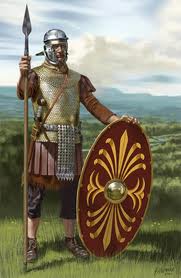
Pet Peeves, Soapboxes, and Hobby Horses

Was Paul intending for his readers to conjure this picture in their minds in Ephesians 6:10-20?

Or this?

Righteousness shall be the belt of his waist, and faithfulness the belt of his loins (Isa 11:5).

How beautiful upon the mountains are the feet of him who brings good news, who publishes peace, who brings good news of happiness, who publishes salvation, who says to Zion, ‘Your God reigns’ (Isa 52:7).

The LORD saw it, and it displeased him that there was no justice. He saw that there was no man, and wondered that there was no one to intercede; then his own arm brought him salvation, and his righteousness upheld him. He put on righteousness as a breastplate, and a helmet of salvation on his head; he put on garments of vengeance for clothing, and wrapped himself in zeal as a cloak. According to their deeds so will he repay, wrath to his adversaries, repayment to his enemies; to the coastlands he will render repayment. So they shall fear the name of the LORD from the west, and his glory from the rising sun; for he will come like a rushing stream, which the wind of the LORD drives. ‘And a Redeemer will come to Zion, to those in Jacob who turn from transgression,’ declares the LORD (Isa 59:15b-20).

I will greatly rejoice in the LORD; my soul shall exult in my God, for he has clothed me with the garments of salvation; he has covered me with the robe of righteousness… (Isa 61:10).